
Health and nutrition are undergoing a structural shift in 2026. According to Innova Market Insights, consumers are not only trying to “stay healthy” — they are actively preparing for long-term wellbeing, prioritizing prevention, healthy aging, and solutions with clearly claimed benefits.
Innova’s research also indicates that 50% of consumers globally have strong concerns about their health, pushing nutrition beyond the status quo and toward more holistic, science-informed choices. Prevention, personalization, and natural wellness are at the heart of this evolution. Below, we explore the major health trends shaping 2026 — with a focus on GLP-1, women’s health, longevity, and other key themes emerging from Innova’s Top Health & Nutrition Trends for 2026.
Key Highlights – 2026 Health & Nutrition trends
- GLP-1 reshapes weight management, appetite, and functional foods.
- Women’s health goes life-stage targeted: hormones, energy, cognition.
- Longevity focuses on healthspan: immunity, vitality, and mental resilience.
- Consumers demand personalized, science-backed, holistic wellness.
- Preventive strategies, gut–brain health, and mental wellbeing drive product innovation.
From “being healthy” to proactive wellness
The macro context highlighted by Innova shows:
- population aging
- the shift toward preventive health and self-care
- growing interest in personalized nutrition
- rising influence of scientific breakthroughs
Consumers are no longer satisfied with generic “healthy” products. They increasingly look for clear functional benefits, scientifically supported claims, nutrition that addresses specific goals such as immunity, sleep, digestion or metabolic health.
This mindset shift is the foundation for all the 2026 health trends.
The GLP-1 era: Transforming nutrition & weight management
The rise of GLP-1 receptor agonists — originally developed for metabolic health and glucose management — continues to reshape weight management, appetite control, and nutritional expectations in 2026. What began as a scientific breakthrough is now influencing the broader landscape of health, supplements, and functional foods, marking a clear lifestyle pivot.
- Brand are looking for solutions designed to support gut comfort, nutrient absorption and appetite regulation for GLP-1 users — especially as digestive tolerance remains a common concern.
- Beyond GI support, product positioning has expanded to address macronutrient balance, muscle preservation, satiety support and micronutrient gaps that can arise during intentional reduced caloric intake.
“Weight Shift” is one of Innova’s key trends for 2026. Innova data indicates that:
- 1 in 2 consumers globally identifies weight management as the main physical health concern
- 66% of those concerned have experienced weight problems and wish to improve health
- 31% focus on prevention and maintenance
- GLP-1 users report higher interest in protein, fiber, and vitamins/minerals, alongside reduced sugar and fat intake.
In short, GLP-1 is no longer just a new category — it’s a catalyst for a wider “weight shift,” driving new consumer behaviors, product design, and nutritional innovation across the health and nutraceuticals space in 2026.
Women’s health: targeted, life-stage nutrition
Women’s health is finally receiving the attention it deserves in 2026. “Her Health” is a major Innova trend this year, highlighting how nutrition and wellness solutions are increasingly tailored to women across life stages.
Innova research shows that women are invested in gender-specific nutrition, with a heightened focus on hormone balance:
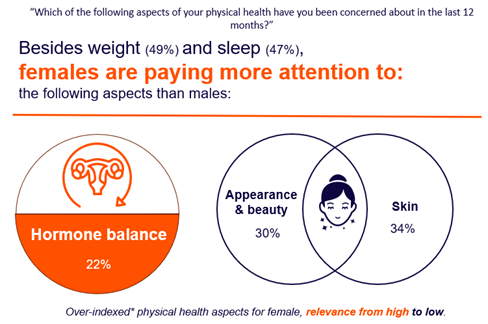
Innova Trends Survey 2025 (Average of 11 countries), Innova Health & Nutrition Survey 2025 (Average of 11 countries)
*Over-indexed options are indicated by standardized residual analysis (P<0.05)
Life-stage distribution further emphasizes diverse nutritional needs:
- 29% are in their natural menstrual cycle
- 5% are in pregnancy or postpartum
- 37% are pre-, peri-, or post-menopausal
Beyond life stage alone, the female hormonal cycle itself is gaining attention as a driver of nutritional needs. Fluctuations across the month can influence mood, stress sensitivity, cravings, comfort, and energy — increasing interest in solutions that support premenstrual balance (PMS), emotional wellbeing, and daily resilience.
These stages create distinct nutritional priorities that support women across hormonal transitions, notably for menstrual cycle support — hormone balance, mood stability, comfort, and energy — and for the menopause transition, including cognitive support, metabolism, emotional balance, and healthy aging.
What’s different in 2026: Women’s health innovation is no longer siloed — it’s a multi-axis category addressing hormonal balance, mood, metabolism, mental agility, and life-stage transitions.
Longevity & healthy aging: A cross-generational priority
Healthy aging is no longer just a concern for older adults — it’s a top priority across generations, with consumers increasingly seeking not only to age well, but to actively support their vitality and functional health over time.
- Innova Market Insights reports that 73% of consumers worldwide rate healthy aging as extremely or very important, making longevity a top personal priority.
- Consumers are moving from “being healthy” to actively preparing their wellbeing, prioritizing prevention, daily support, and clearly perceived benefits.
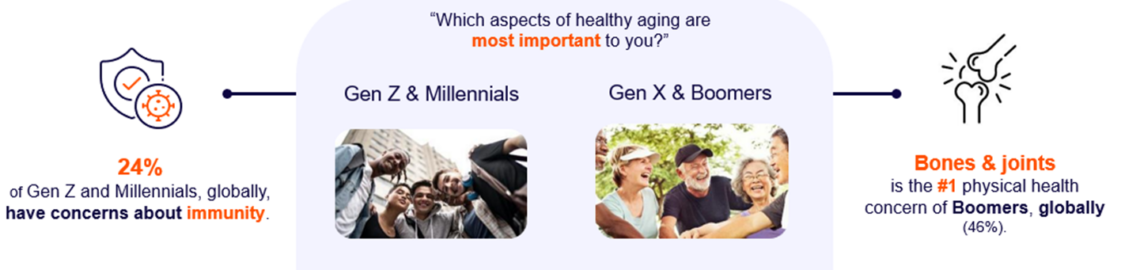
Top Health & Nutrition Trends for 2026 – Global
Longevity innovation creates strong fields of opportunity, extending into metabolic health, gut and microbiota balance, bone and joint health, muscle maintenance, cognitive preservation, immunity, cardiovascular support, energy, sleep, and stress management — reconnecting diet and lifestyle with both functional and cellular aging mechanisms.
This shift reflects a broader redefinition of longevity — from simple age extension to proactive healthspan enhancement, focusing on cellular regeneration, physical mobility, mental performance, and quality of life at every age.

Emerging health priorities in 2026
Beyond the headline trends, several cross-cutting themes are shaping consumer expectations and opportunities for brands:
- Personalized health & preventive wellness
Consumers increasingly seek health solutions tailored to their lifestyle — from customized supplement to AI-driven diet guidance and proactive health diagnostics. - Mental wellness & stress resilience
Emotional health is a core component of overall wellbeing with 49% of consumers reporting strong concern about mental health. Stress, sleep, and nutrition are now inseparable, driving demand for adaptogens, magnesium, and other cognitive-support ingredients - Gut–brain axis & microbiome awareness
Products targeting the microbiome are valued not only for digestion but also for immunity, mood, and metabolic health, reflecting a broader understanding of the gut–brain connection. - Preventive diagnostics & technology
At-home testing and wearable devices are empowering consumers to track sleep, metabolism, and aging markers, fueling proactive health management and personalized interventions.
These emerging priorities demonstrate that health innovation in 2026 extends beyond single categories — it’s about holistic, integrated, and actionable solutions that allow consumers to anticipate and manage their wellness in a targeted way.
Final Thought
Across all trends, the core theme is clear: nutrition is now an active, evidence-based tool to live healthier, longer, and more balanced lives. Consumers want prevention over reaction, personalization over one-size-fits-all, and clarity over confusion — and brands that deliver on these expectations will define the future of wellness.
Contact us to explore 2026 health trends for your brand ⤵️

Leslie Lannebere
International Marketing Manager, Nexira
Sources: Top Health & Nutrition Trends for 2026 – Global
This communication is not intended to the final consumer. It provides scientific information for professionals only. Communication to final consumer has to be checked according to local regulation in force, since the conditions of use are beyond our control. This statement has not been evaluated by the FDA. These products are not intended to diagnose, treat, cure or prevent any disease.