Looking beyond PAC content for women’s urinary health
Key highlights
- The study reinforces the importance of ingredient characterization, standardization and clinical substantiation when selecting cranberry ingredients for women’s health formulations.
- A newly published clinical study evaluated three cranberry formulations, including Exocyan™ Cran 40G, in 219 women with recurrent urinary tract infections over six months.
- Exocyan™ Cran 40G showed greater improvements on several quality-of-life and symptom-related measures.
- The research goes beyond PAC quantity alone by investigating how cranberry composition and PAC profiles may influence outcomes.
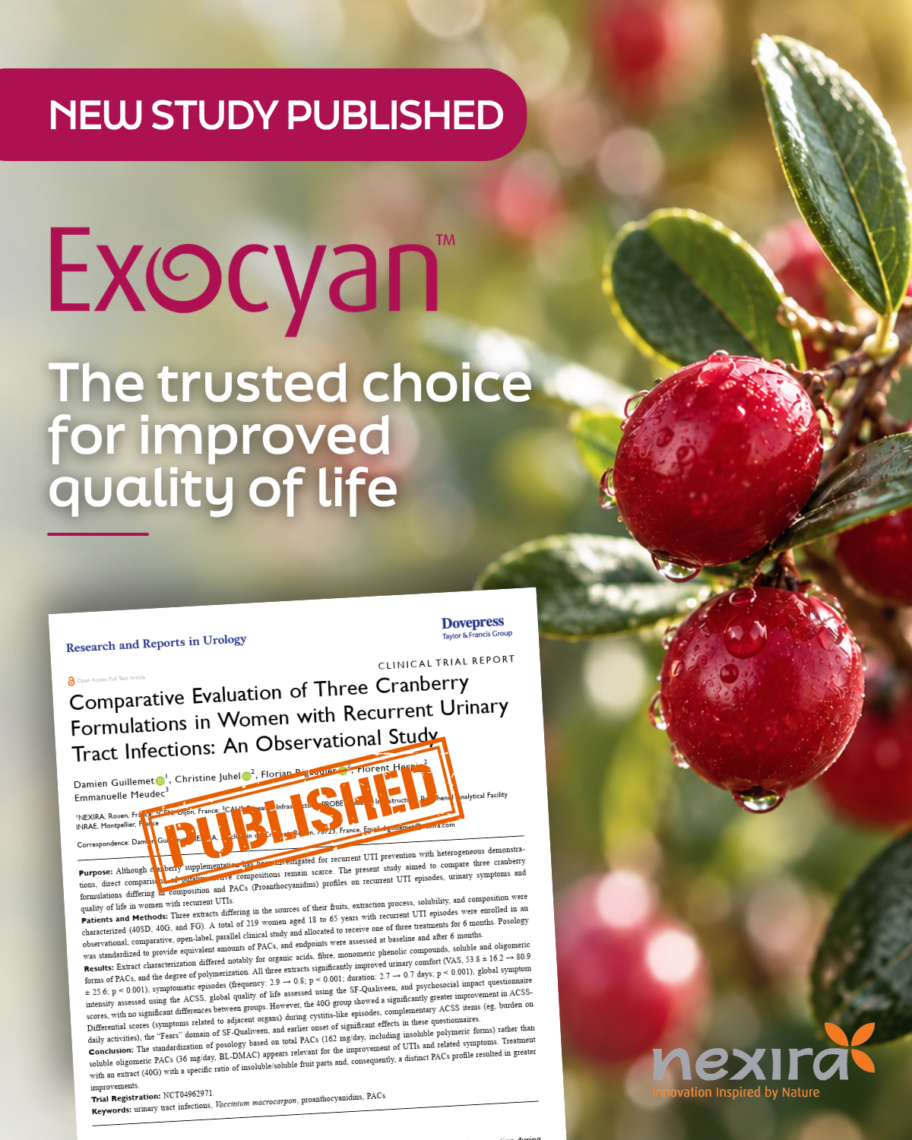
Nexira’s new clinical study evaluating three cranberry formulations in women with recurrent urinary tract infections has just been published in the peer-reviewed journal Research and Reports in Urology.
Conducted in 219 women over six months, the study provides new clinical evidence on the benefits of cranberry supplementation for urinary comfort and quality of life. More importantly, it goes one step further by exploring how differences in cranberry composition and proanthocyanidin (PAC) profiles may influence outcomes.
The publication brings a new perspective to a well-established ingredient. Cranberry has long been considered a reference botanical for women’s urinary health, but as research advances, the question is no longer simply whether cranberry can support urinary comfort. Ingredient quality, composition, standardization and clinical substantiation are becoming increasingly important when selecting the right cranberry solution.
These expectations reflect a broader evolution in women’s health. As explored in our article Women’s Health – From hormonal cycles to menopause, the category is moving away from generic women’s wellness solutions towards more targeted approaches addressing specific needs across different life stages.
Urinary health is one of these major areas of need.
Women’s urinary health: a persistent concern requiring better-targeted solutions
Women’s health is entering a new era of more targeted, science-backed nutrition. Rather than treating women’s wellness as a single category, innovation is increasingly structured around specific needs and life stages, from menstrual and hormonal health to emotional balance, healthy aging and urinary comfort.
This evolution is followed by higher expectations for scientific substantiation. Brands and formulators increasingly need ingredients supported by human clinical research, rigorous quality and standardization criteria. Urinary health illustrates this need particularly well.
Urinary tract infections are among the most common bacterial infections affecting women, with more than half of women experiencing at least one UTI during their lifetime. Recurrent episodes can also extend well beyond physical discomfort, affecting daily activities, emotional well-being and overall quality of life.
Cranberry has long been one of the reference natural ingredients in this field. But as the science progresses, an important question is emerging: are all cranberry ingredients equivalent?
More than half of women experiencing at least one UTI during their lifetime.
Cranberry efficacy: why PAC content is only part of the story
Cranberry (Vaccinium macrocarpon Aiton) contains a complex combination of bioactive compounds, among which proanthocyanidins (or PACs) have received particular scientific attention.
PACs with A-type linkages are notably studied for their interaction with bacterial adhesion mechanisms in the urinary tract. For this reason, PAC standardization has become an important criterion in cranberry supplementation. However, cranberry composition is complex.
Different parts of the fruit, extraction processes and analytical methods can result in ingredients with significantly different compositions and PAC profiles. Nexira’s previous work on Exocyan™ already highlighted the importance of controlling cranberry authenticity, traceability and analytical characterization rather than relying solely on a declared cranberry or PAC content.
Newly published clinical research now provides further insight into this question.
New study: comparing three cranberry formulations in 219 women
In September 2026, a new peer-reviewed study entitled Comparative Evaluation of Three Cranberry Formulations in Women with Recurrent Urinary Tract Infections: An Observational Study was published in Research and Reports in Urology.
The research evaluated 219 women aged 18 to 65 with recurrent UTIs, who consumed one of three cranberry formulations, including Exocyan™ Cran 40G, for six months.
The three formulations differed in their fruit fractions, extraction processes, solubility and composition.
Importantly, their daily dosages were adjusted to provide the same amount of total PACs (Bate-Smith): 162 mg/day.
Researchers then evaluated not only urinary symptoms and recurrence characteristics, but also urinary comfort and quality of life, while carrying out detailed characterization of the different cranberry compositions.
This approach provides an important perspective: rather than simply asking whether cranberry works, the study investigated whether differences in cranberry composition could influence clinical outcomes.
Significant improvements in urinary comfort and symptomatic episodes
Across the three cranberry formulations, supplementation was associated with significant improvements in urinary health.
Overall urinary comfort increased, representing an improvement of approximately 50% from baseline.
The average frequency of symptomatic episodes decreased from 2.9 to 0.8, while their average duration decreased from 2.7 to 0.7 days.
Improvements were also observed in overall symptom intensity, quality of life and psychosocial impact.
One particularly interesting observation was the speed of the response: significant improvements in urinary comfort were already reported after the first weeks of supplementation and continued throughout the six-month period.
These findings are especially relevant because recurrent urinary discomfort is not limited to physical symptoms. Previous work with Exocyan™ has shown that it can affect concerns around everyday situations such as access to bathroom facilities, sexual intercourse or insufficient fluid intake. Addressing urinary health therefore also means considering its impact on women’s daily lives.
The study identified an interesting differentiation for Exocyan™ Cran 40G. This formulation combines purified cranberry juice and pomace, giving it a specific ratio of soluble and insoluble fruit fractions and a distinctive PAC profile.
From cranberry sourcing to clinical substantiation
This new publication also reinforces Nexira’s broader approach to Exocyan™: controlling the ingredient from raw material selection through manufacturing, analytical characterization and clinical research.
Exocyan™ is exclusively manufactured from Vaccinium macrocarpon Aiton. Nexira uses recognized analytical methods including BL-DMAC and Bate-Smith, alongside a proprietary UPLC method designed to characterize the raw material and detect potential adulteration.
The range can incorporate cranberry juice, pomace or combinations of both, allowing different cranberry compositions and PAC profiles to be developed according to formulation objectives.
With Exocyan™, Nexira combines cranberry sourcing and extraction expertise, advanced analytical characterization and human clinical research to support the development of scientifically substantiated urinary health solutions.
Get in touch to receive a sample or book a meeting with our team!

Caroline Jourdain
Technical Support, Nexira
Sources : Comparative Evaluation of Three Cranberry Formulations in Women with Recurrent Urinary Tract Infections: An Observational Study
This communication is not intended to the final consumer. It provides scientific information for professionals only. Communications to the final consumer have to be checked according to local regulations in force, since the conditions of use are beyond our control. This statement has not been evaluated by the FDA. This product is not intended to diagnose, treat, cure, or prevent any disease.