Beverage emulsions: Expert insights from Bastien Berepion
Creating a stable beverage emulsion may look straightforward: combine an oil phase with an aqueous phase, homogenize the system and obtain sufficiently small droplets. In practice, however, long-term stability depends on a combination of ingredient selection, stabilization and processing conditions.
Ahead of his presentation at the Microencapsulation Conference on September 23, we spoke with Bastien Berepion, Ph.D., Global Technical Support Manager – Nexira Food Division, about some of the key principles behind stable beverage emulsions and the formulation challenges faced by beverage developers.

Bastien, what makes beverage emulsions particularly challenging to formulate?
Scientifically speaking, a simple dispersion of flavors or other lipophilic compounds in water naturally tends to separate. When preparing a beverage emulsion, the goal is to stabilize this dispersion.
To achieve a kinetically stable emulsion throughout the product’s shelf life, Acacia gum is a key ingredient thanks to its natural emulsifying and stabilizing properties. Its emulsifying properties help form fine, uniform oil droplets, while its stabilizing properties prevent physical phenomena that compromise stability, such as coalescence, creaming, or flocculation.
The role of Acacia gum is therefore not limited to creating and stabilizing the emulsion in its concentrated form; it also maintains stability after dilution, ensuring the finished product remains stable throughout its shelf life.
What keeps an oil-in-water emulsion stable?
Emulsion stability is the result of several complementary mechanisms working together. For example, with Acacia, stabilization relies on three key effects:
First, Acacia adsorbed at the oil-water interface forms a layer around the oil droplets, preventing them from merging and limiting coalescence.
Second, the Acacia polysaccharide network in the continuous phase reduces droplet mobility, further inhibiting gravitational phenomena such as creaming.
In addition, the adsorbed hydrocolloid layer around the droplet has also an impact on its specific gravity which helps to slows down gravitational separation.
Finally, thanks to the glucuronic acids naturally present in Acacia, Acacia molecules take a negative charge when diluted in water inducing electrostatic repulsion between droplets preventing from flocculation. This is why emulsion stability should never be evaluated through droplet size alone. We must consider the complete system, what happens at the interface and the characteristics of the continuous phase.
So droplet size is important, but it isn’t the only parameter formulators should consider?
Exactly. Achieving small oil droplets is essential, but droplet size distribution and its evolution over time are equally critical.
During development, relying solely on visual observation is not enough. At Nexira, we combine two complementary analytical tools to monitor emulsions: Turbiscan and laser granulometry.
Turbiscan analysis detects early destabilization phenomena (such as creaming or flocculation) long before they become visible to the naked eye.
Laser granulometry checks the oil droplet size distribution and, in case of instability, helps us understand the underlying mechanisms (such as coalescence or Ostwald ripening).
While Turbiscan confirms if the emulsion remains physically stable, laser granulometry explains why by looking directly at droplet behavior. Combining both gives formulators a complete overview of formulation robustness.

How important is the process compared with the choice of emulsifier?
They cannot really be separated. Even if you use a high-performing emulsifier, it needs to be paired with an optimized process and the right equipment.
A typical oil-in-water beverage emulsion starts with preparing the aqueous phase (dissolving the Acacia gum in water) and the oil phase (containing the flavors or lipophilic compounds).
A critical first step is generating a fine, uniform pre-emulsion under high shear. Here, using the appropriate equipment, specifically the right rotor-stator head for the high-shear mixer, is essential. Inadequate mixing tools won’t achieve optimum droplet breakup during the pre-emulsification step, which directly impacts the performance of the high-pressure homogenization step that follows.
Formulation parameters (such as emulsifier dosage), equipment selection, shear conditions, and homogenization settings must therefore be considered as a single system, as each plays a key role in the final outcome.
What are formulators asking for today that makes this more challenging?
The technical brief is becoming more complex, driven by both commercial and technical requirements.
On the economic side, a major demand today is cost savings, which can be partially achieved by reducing emulsifier dosage.
At the same time, formulators are facing increasingly challenging technical objectives. These include increasing oil or flavor loads, meeting clean label demands (such as removing preservatives, weighting agents or alcohol), and optimizing processes to reduce production time or energy consumption. Very often, formulators are tasked with achieving several of these objectives simultaneously.
Each constraint directly impacts the balance of the system. For instance, reducing emulsifier dosage while increasing the oil phase creates a dual challenge: you have a larger interfacial area to stabilize with fewer active molecules available.
The goal, therefore, is to achieve better performance through a simpler, more cost-effective, and more robust formulation.
Does using more emulsifier necessarily mean a more stable emulsion?
Not necessarily. The objective is not to maximize the amount of emulsifier, but to use an emulsifier efficiently enough to create and maintain optimal interfacial protection.
This is an important distinction because dosage has consequences beyond ingredient cost. Over-dosing can influence viscosity, processing time (specifically dissolution), sensory profile, and even increase the volume of raw materials that need to be transported and stored.
This is where emulsifier efficiency becomes particularly relevant to achieve maximum stability at the lowest effective dosage.
Is this what led Nexira to develop Eficacia™ Advanced?
Yes, absolutely. The aim behind Eficacia Advanced was to push the emulsifying efficiency of acacia gum further while maintaining all the advantages of a 100% natural ingredient.
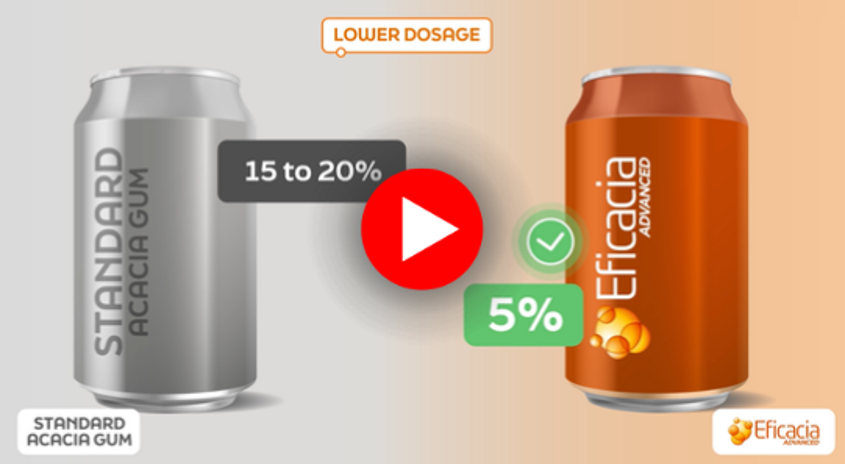
In a standard flavor emulsion, Eficacia™ Advanced was able to achieve full emulsion stability from 5%, compared to the 16–22% typically required with standard acacia gum grades, representing a dosage reduction of up to 65%.
However, lower dosage is only half the equation; processing is equally critical. To make the ingredient as easy to use as possible, Nexira developed an innovative granulation process. The resulting powder is dust-free and fully free-flowing and during dissolution, the granules wet and disperse rapidly. Thanks to this new granulation process, the air entrainment during dissolution is significantly reduced resulting to very low foaming during this step.
What happens when formulators start pushing the system further, for example with higher oil loads?
This is where the performance of the emulsifier becomes particularly important.
Standard formulations typically work with oil loads around 10–15%. Nexira’s trials with Eficacia™ Advanced demonstrated stable emulsions containing up to 25% oil load at a 10% emulsifier dosage.
This is particularly valuable for concentrated flavor systems or functional applications where formulators need to incorporate higher levels of oil-soluble or lipophilic active compounds.
Again, the essential takeaway is that the system must be considered as a whole. Increasing the oil load changes the balance of the system, so emulsifier selection, dosage and processing parameters all need to be adapted accordingly.
What would be your main advice to someone developing a new beverage emulsion?
Take an application-focused approach rather than selecting an emulsifier on its own.
Before choosing your ingredient, clearly define the full scope of your project constraints : What is your target oil load in the concentrate, and what is the dilution ratio in the final beverage? What are your clean label constraints such as do you need a solution without preservatives, weighting agents, or alcohol? What processing equipment is available on site (high-shear mixers, homogenizers)? What level of stability and appearance is expected over the intended shelf life?
Once these application parameters are established, you can select the most efficient emulsification system and optimize the process around it.
Emulsion stability is rarely down to a single parameter, it is always about aligning ingredient functionality, dosage, formulation, and processing to form a coherent system.
Want to explore the performance data behind Eficacia™ Advanced?

Bastien Berepion,
Ph.D., Global Technical Support Manager
Nexira Food Division
This communication is not intended to the final consumer. It provides scientific information for professionals only. Communication to final consumer has to be checked according to local regulation in force, since the conditions of use are beyond our control. This statement has not been evaluated by the FDA. These products are not intended to diagnose, treat, cure or prevent any disease.